
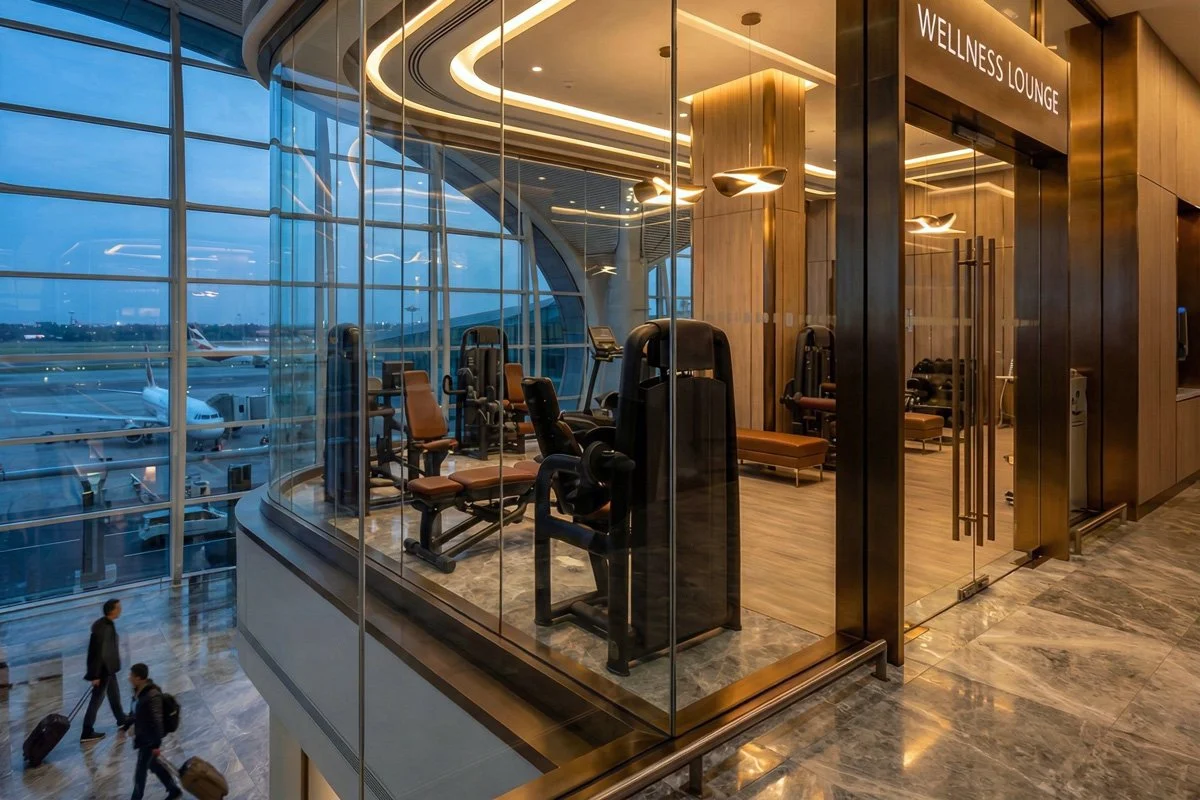
Airports have never been designed for humans at their best. They’re designed for throughput. For security. For efficiency. For getting as many people as possible from Point A to Point B with minimal disruption. And somewhere along the way, we all accepted that discomfort was just part of the deal.
Stiff backs. Tight hips. Elevated stress. Hours of sitting. Disrupted sleep. Adrenaline spikes followed by exhaustion.
So when U.S. Transportation Secretary Sean Duffy recently suggested incorporating fitness and movement spaces into airport terminals, it wasn’t just an interesting headline … it was a signal. A quiet acknowledgment that the way we’ve designed travel may finally be catching up to how bodies actually work.
Travel Is Physically Demanding — We Just Pretend It Isn’t
Anyone who trains consistently understands this instinctively: movement isn’t optional. It’s maintenance.
Yet airports … places where people are often trapped in their bodies for hours at a time, have historically offered little more than chairs, moving walkways, and overpriced neck pillows. The irony is that airports may be one of the most logical places to support intelligent movement. Travel compresses time. Layovers create short windows. Stress accumulates quickly. A well-designed movement space doesn’t need to be large … it needs to be intentional. Ten minutes of movement can completely change how someone arrives at their destination. Trust me, I know.
Fitness Spaces Are Not Just “Equipment”
This is where the conversation often goes sideways. When people talk about adding gyms to unconventional environments, the instinct is to think in terms of equipment: a treadmill here, a rack there, maybe a mirror if someone’s feeling ambitious. But real fitness environments, especially public ones, don’t succeed because of what’s placed in them. They succeed because of how they’re designed.
At Iron House, every space starts with questions like:
How will people enter and exit this space?
How long will they realistically be here?
What emotional state are they arriving in?
What materials feel grounding, not institutional?
How does sound, light, and openness affect stress?
An airport fitness space isn’t about performance theatrics. It’s about restoring circulation, posture, and nervous system balance … quietly, efficiently, and without intimidation. That requires design intelligence, not just gear.
Why Airports Might Actually Be Ideal for Wellness
Airports already excel at many of the hardest parts of public-space design:
Durability
Hygiene
Accessibility
Clear wayfinding
Safety and visibility
What’s been missing is the layer that understands how bodies move, especially under stress. Thoughtful movement zones, mobility areas, short-form strength stations, and recovery-oriented spaces fit naturally into terminals when they’re designed intentionally. Not as novelties. Not as marketing moments. But as functional infrastructure.
This isn’t about creating boutique gyms in Terminal C. It’s about acknowledging that movement supports clarity, calm, and resilience. All things travelers need more of.
A Larger Shift Is Happening
This moment isn’t really about airports. It’s about something bigger. We’re starting to see wellness recognized not as a luxury, but as a baseline requirement of good design … even in public, government-funded spaces.
When movement is treated as infrastructure, everything changes. Expectations rise. Standards improve. And design becomes the differentiator between spaces that simply exist and spaces that actually serve people. Iron House has spent decades designing environments where training, longevity, and mental clarity are taken seriously … whether for private clients, elite performers, or government facilities.
If airports are stepping into this conversation, they deserve the same level of thoughtfulness. Because how we move through spaces shapes how we feel when we leave them.
And that’s not a small thing.