The Complete Guide to Designing a Home Gym or Wellness Space in 2026
At Iron House, we don’t “build home gyms.” We design daily rituals — private, architectural sanctuaries where performance, longevity, and aesthetic integrity all work together.
Since 2023, we’ve been the only home gym design firm accepted into the AD PRO Directory, recognized for our ability to blend high-performance training environments with interiors worthy of luxury residences. Below is the foundational blueprint we use on every project — the same approach behind the home gyms, Pilates rooms, recovery suites, and wellness wings we design for clients across the country.
In This Guide:
- Why a Luxury Home Gym Has Become the New Essential Room
- What “Luxury” Actually Means in a Home Gym
- How Much Space You Actually Need
- Zoning: The Secret That Turns a Room Into a Ritual
- Choosing the Right Equipment (For Your Body, Not Instagram)
- Design & Aesthetics — Making the Gym Beautiful
- Flooring — The Foundation of a Proper Gym
- Wellness & Longevity Rooms — The New Luxury Standard
- The Construction Details Most Designers Miss
- Investment Guide: What Luxury Actually Costs
- Timeline: From First Call to First Workout
- Working With Iron House: Our Process
- Common Mistakes to Avoid
- Frequently Asked Questions
Why a Luxury Home Gym Has Become the New Essential Room
There’s a reason the home gym has become one of the most important rooms in the modern home — and it has nothing to do with trends or convenience. The data is clear: people with a well-designed home gym are 40% more consistent with their training, report 25% better sleep, and experience 30% lower perceived stress.
Home wellness spaces now rank as a top three priority among high-net-worth homeowners, and properties with dedicated gyms and recovery suites routinely see a 5–12% increase in resale value.
But here’s the part most people don’t realize: most spare-room gyms fail within 90 days. Not because people lack discipline, but because the space was never designed to support their habits in the first place. A treadmill in the corner is not a gym — it’s guilt on a floor mat.
A true luxury home gym becomes the room you walk into every single day because it gives you something back: energy, structure, clarity, and time. It feels like possibility, not punishment.
Once people experienced what it felt like to train at home — without the commute, the locker room chatter, the waiting for equipment — they realized the best hour of their day didn’t need to be outsourced. And for many of our clients, that realization became permanent.
When designed correctly, the home gym becomes the room you use more than any other.
What “Luxury” Actually Means in a Home Gym
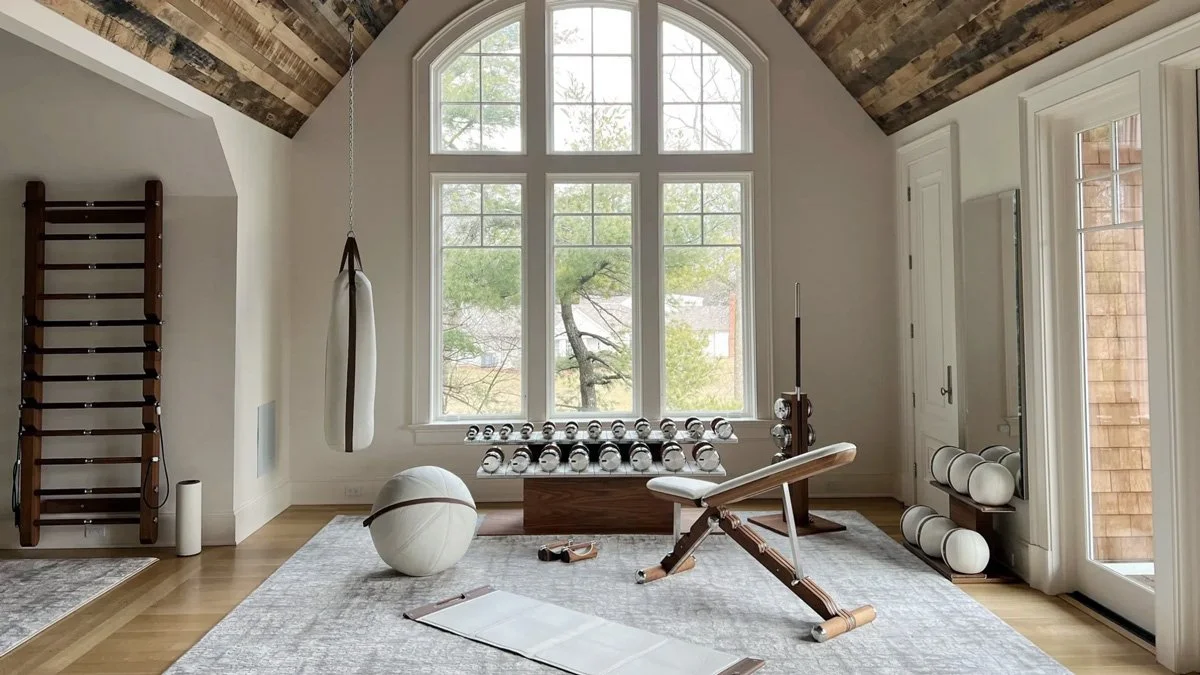
Luxury in 2026 has nothing to do with logo-plastered equipment or neon signs glowing in a dark basement. True luxury is sensory. It’s emotional. It’s architectural. It’s the experience of stepping into a room and feeling your nervous system shift from stress to calm in seconds.
A luxury gym feels like it belongs to both your home and your body — not to Instagram. It supports your routines, physiology, and longevity with the same level of intention you bring to the rest of your life.
The Seven Design Principles of Modern Luxury
1. Seamless Architectural Integration
A luxury gym should feel designed into your home, not added onto it. We match millwork, coordinate finishes, and create transitions that make the room feel native to your architecture.
2. Psychological Flow Through Intelligent Zoning
Visual calm creates mental clarity. Clear zones reduce decision fatigue and allow multiple people to train without conflict. When the room makes sense at a glance, you use it more.
3. Biophilic & Circadian Lighting
Lighting is medicine. Natural light where possible; tunable circadian LEDs where it’s not. No fluorescents. No harsh shadows.
4. Equipment Curated for Your Body
Luxury equipment is about fit, not price. We select based on height, mobility, injury history, training style, and daily rhythm.
5. Materials That Age Gracefully
True luxury materials don’t wear out — they wear in. Oak, plaster, stainless steel, and vegetable-tanned leather gain character over time.
6. Longevity Technology Integrated Naturally
Infrared saunas, cold plunges, red light therapy, compression systems, PEMF, and even hyperbaric oxygen (in estate homes) extend recovery and performance.
7. Acoustics & Ventilation Engineered for Calm
Clean air, quiet acoustics, ideal temperature — luxury is often invisible. But you feel it the second you walk into the room.
Luxury isn’t purchased — it’s felt.
How Much Space You Actually Need
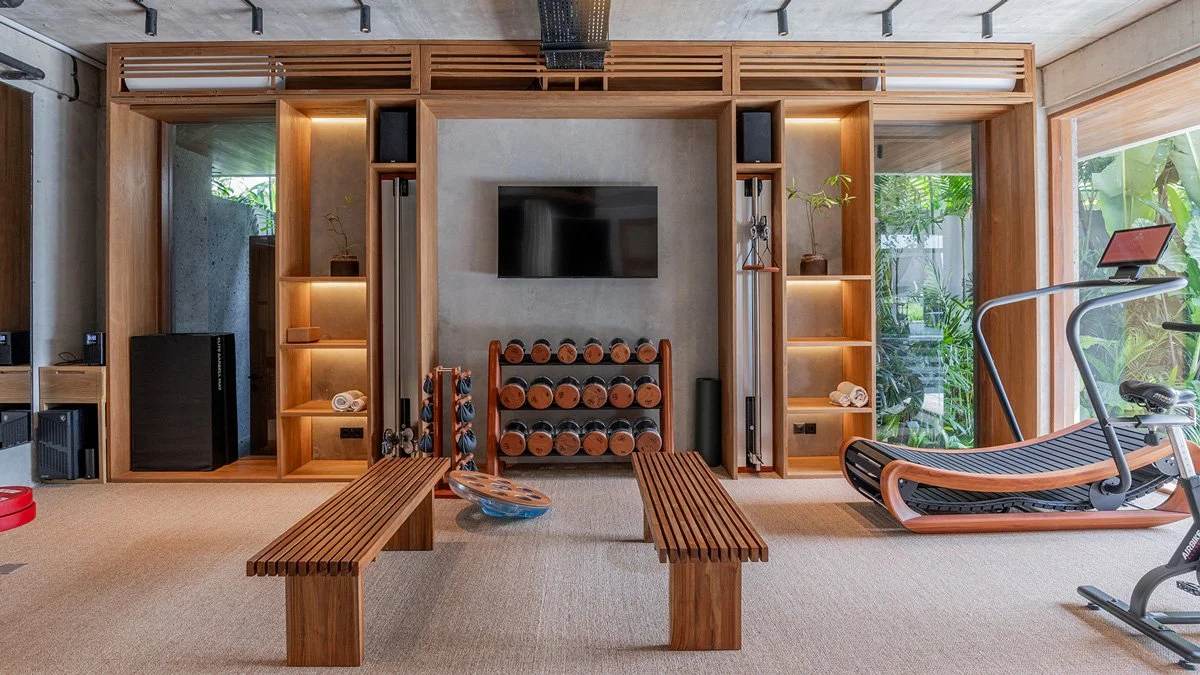
The most common question we hear is, “Will this even work in my home?” And the answer is almost always yes. You don’t need a massive footprint to build a high-functioning luxury gym — but the design changes dramatically based on square footage, ceiling height, and how many “zones” you want the room to hold.
Here’s the truth: the goal isn’t more space. The goal is clean movement — enough clearance to train safely, enough breathing room to keep the space calm, and enough storage to prevent the slow creep into chaos.
Quick Space Guidelines (What Actually Works)
Compact (150–300 sq ft)
The “zero excuse” gym: a real strength foundation + one cardio piece + a defined mobility/mat zone. This is where zoning matters most — and where good design makes the biggest difference.
Optimal (300–500 sq ft)
The sweet spot. You can build true zones: strength, cardio/functional, mindful movement, and mobility — plus room for a meaningful upgrade like a sauna or a recovery corner, if you are closer to the 500 sq ft size.
Luxury (500–1,000+ sq ft)
Full gym + dedicated Pilates/yoga studio. Ideal for multi-user households, private training sessions, and true architectural integration.
Estate (1,000 - 2,000 sq ft)
Full gym + dedicated Pilates/yoga studio + longevity suite (sauna, plunge, red light, recovery lounge). Ideal for Athletes and multi-user households.
The “10×10 Rule” (A Simple Test)
If you have a clear 10×10 area (100 sq ft), you can train safely with a barbell and a rack setup. That doesn’t mean it will feel luxurious — but it means it can function. Luxury comes from what you add around it: circulation paths, storage, lighting, and visual calm.
Ceiling Height Cheat Sheet (This Changes Everything)
- 8 ft ceilings: workable for many gyms, but can limit pull-ups, overhead work, and some Pilates/standing work
- 9–10 ft ceilings: ideal for racks, athletic movement, and a room that feels open (not compressed)
- Pilates standing work: certain standing exercises on reformer platforms can require ~106.5 in (about 8'10") depending on height
Equipment Footprints & Real-World Clearances
Equipment “dimensions” are just the object. What matters is the usable footprint — the machine plus safe entry/exit, walking space, and movement clearance.
- Rowers (Concept2 style): machine length is about 96 in (8 ft) — plan closer to 9 ft of run so you’re not wedged against a wall.
- Treadmills: most are roughly 6 ft long x ~3 ft wide, but safety guidelines commonly recommend keeping 6–7 ft open behind and meaningful clearance to the sides for safe dismounts.
- Pilates reformers: many are roughly 93–100.5 in long and 26.5–29.25 in wide; plan additional space around the machine for mounting/dismounting and side work.
- Power racks: many racks are around 90 in tall; you also need comfortable clearance for overhead movement and, if you’re doing pull-ups, headroom becomes the limiting factor.
- Functional training zone: a clear 10×10 area is an ideal “movement box” for sled work, kettlebells, mobility, and athletic patterns — and 6×6 can work for lighter movement if the room is tight.
Garages & Basement Conversions
Garages often win on ceiling height and ventilation (and they’re naturally forgiving for lifting noise). Basements win on privacy and temperature stability — but they frequently need moisture control, dehumidification, and smarter lighting.
Floor Load Considerations (The Responsible Answer)
Most residential floors are designed around a uniform live-load standard commonly referenced at 40 lb/sq ft for “rooms other than sleeping rooms,” with bedrooms often lower. Heavy gym equipment isn’t always a uniform load — it can be concentrated. That’s why we treat anything truly heavy (barbells + plates, large machines, saunas/plunges) as a coordination item with your builder and, when needed, a structural engineer.
Rule of thumb: if you’re placing a serious strength setup, plate-loaded machines, or multiple heavy pieces on an upper floor, we plan it intentionally — location, reinforcement, noise isolation, and floor protection — before anything is ordered.
Zoning: The Secret That Turns a Room Into a Ritual
If there’s one reason home gyms go unused, it’s this: everything ends up living in the same 8×8 corner. The dumbbells creep into the yoga space, the rower blocks the mirror, the bands tangle with the jump rope — and before long, the room feels chaotic. And when a space feels chaotic, you avoid it.
Zoning fixes that instantly. Clear, intentional zones create calm, clarity, and safety. They give each movement its own psychological identity and transform your gym from a “random workout room” into a daily ritual you look forward to.
The Six Essential Zones
1. Strength & Free Weights — The “Get Strong” Zone
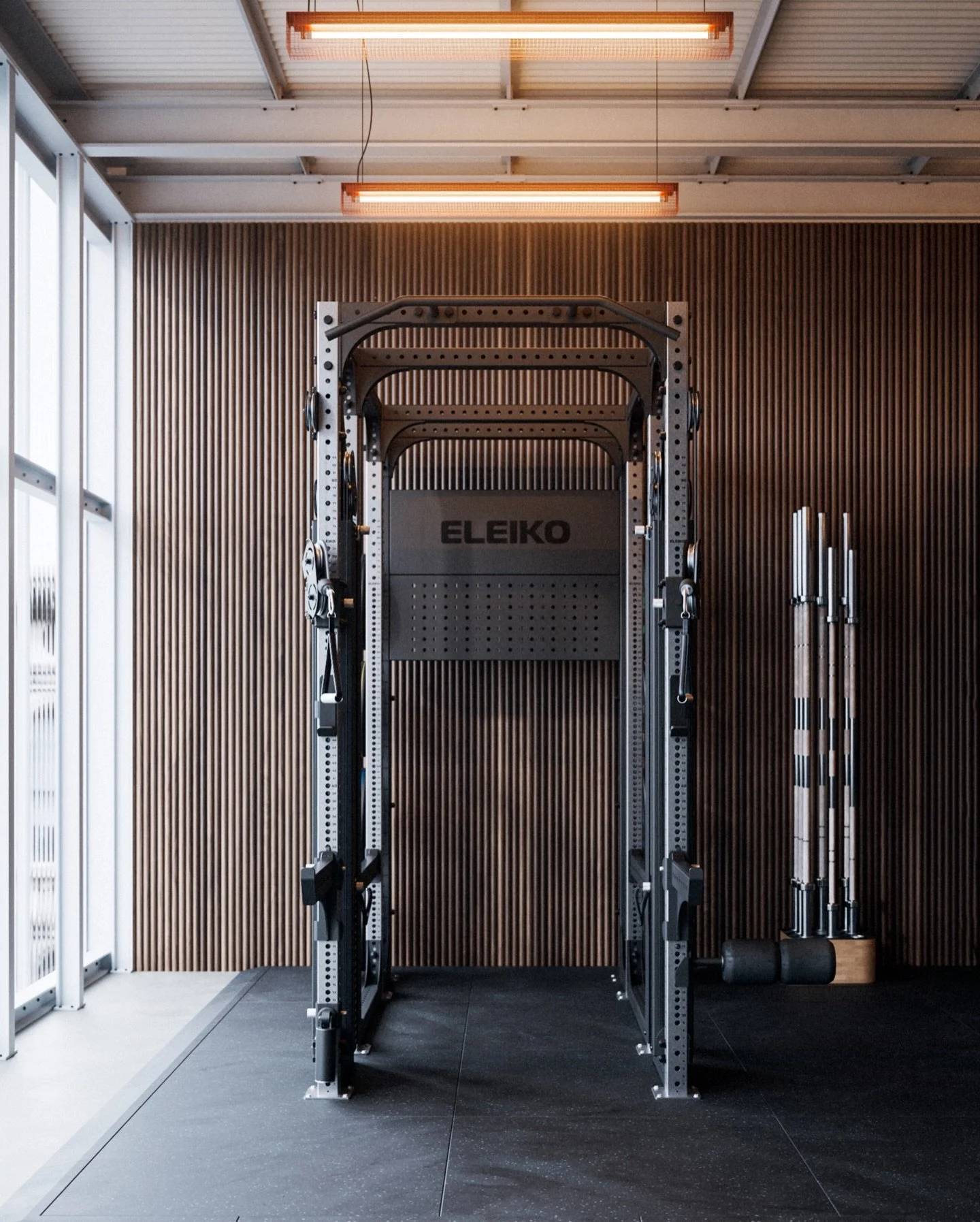
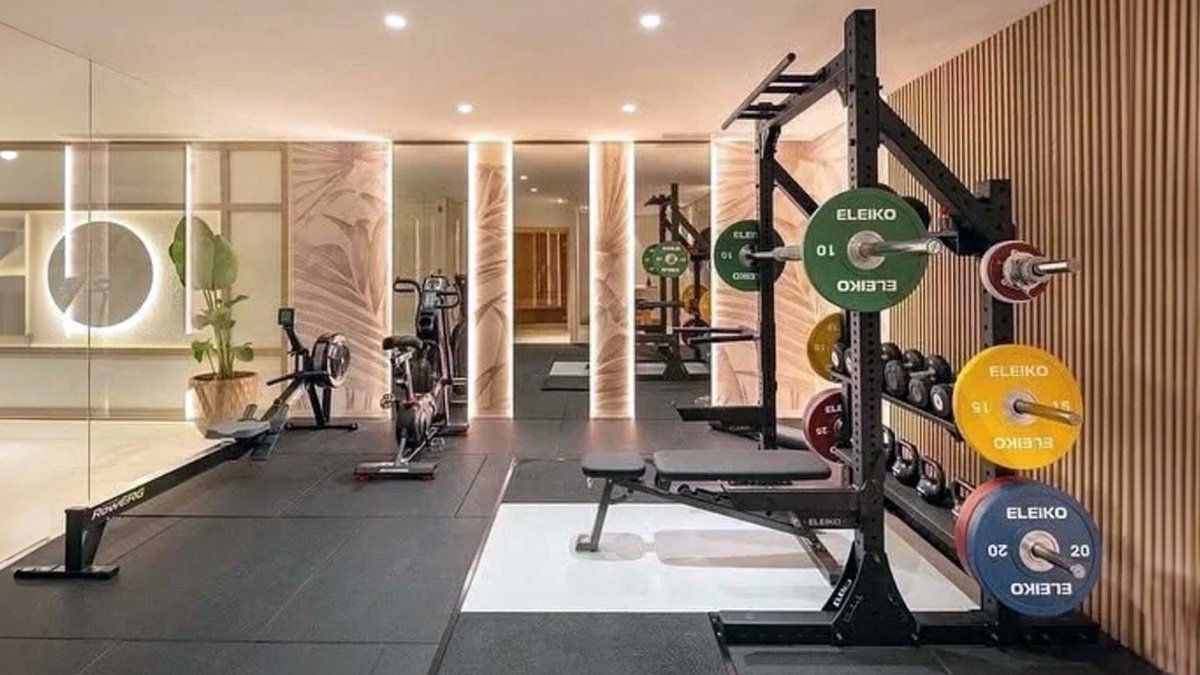
The anchor of most home gyms. Squat rack or cage, barbell and plates, organized dumbbells, adjustable bench. Always placed against a structural wall, ideally with natural light. Flooring is rubber or a lifting platform. This zone should feel grounded, intentional, and built for real work.
2. Functional Training & Cardio — The “Get Sweaty” Zone
Your movement-driven area: an Assault Bike or SkiErg, a rower or treadmill, a sled track if space allows, kettlebells, ropes, and medicine balls. This zone needs open floor space and vertical clearance. Use turf or rubber. It should feel expansive — the part of the room that says, “Let’s go.”
3. Mindful Movement — The “Get Aligned” Zone
Reformers, mat space, props, and ideally a floor-to-ceiling mirror wall. We design this zone away from the weight of Zone 1 and give it softness: natural light, warm flooring, calm visuals. This is your mental reset zone — grounded, focused, restorative.
4. Mobility & Breathwork — The “Get Quiet” Zone
Foam rollers, massage tools, stretching mats, breathwork cushions — sometimes a pull-up bar for decompression. Best in a corner or alcove. Soft lighting, warm flooring, minimal equipment. This is the space where your body transitions in and out of training — where longevity begins.
5. Recovery Suite — The “Get Restored” Zone
Recovery is no longer optional. Here we place saunas, cold plunges, red light therapy, compression systems, or massage chairs. Ideally a separate room, but in gyms 400+ sq ft, it can integrate effortlessly. Wet areas get tile; dry areas use LVP or wood. This zone should feel like a private spa — quiet, restorative, and yours alone.
6. Storage & Transition — The “Get Organized” Zone
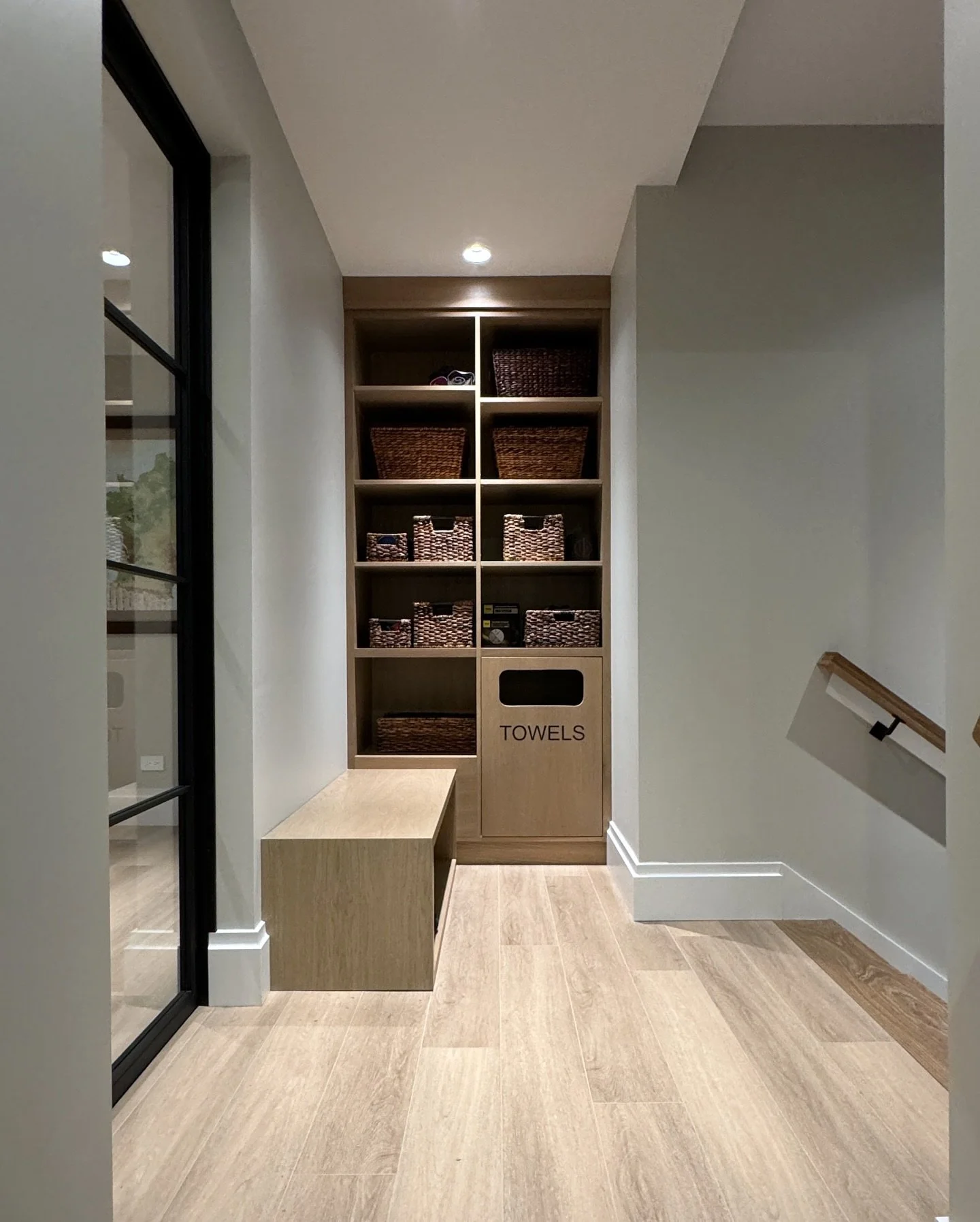
Hidden storage for bands, collars, props, chalk, towels, shoes, and a mini-fridge. Often with a small entry bench. This is the least glamorous zone — and the one that determines whether your gym stays beautiful or becomes a disaster. It removes friction so consistency increases.
Zoning for Multi-User Households
- Partner workouts: Strength (Zone 1) + Cardio/Functional (Zone 2)
- Parent + teen: Adult in Zone 1; teen in Zones 2 or 3
- Morning overlap: Strength in Zone 1; Pilates/Yoga in Zone 3
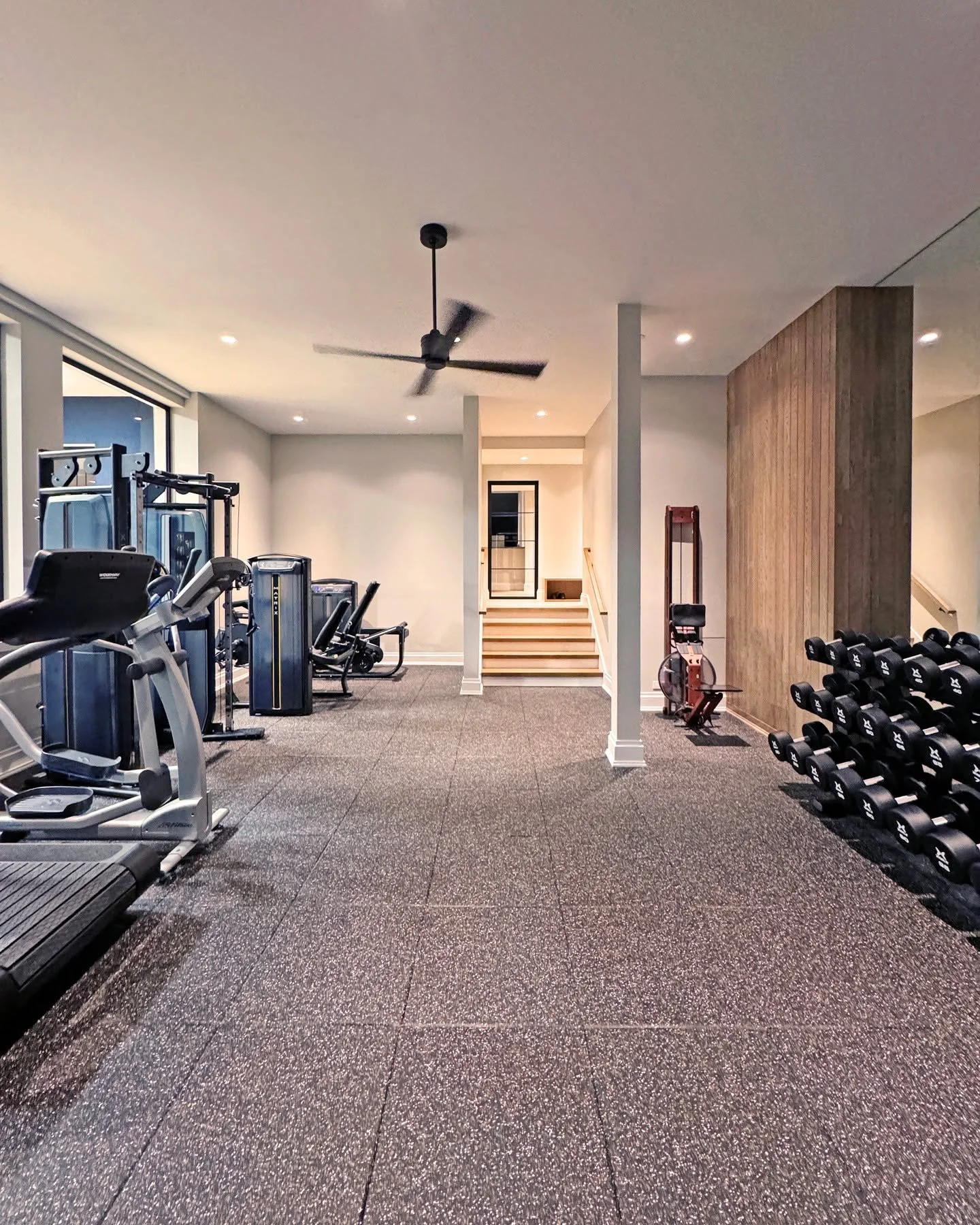
One of our favorite design tricks: strategic equipment placement — or even a single structural column — creates natural separation without adding walls.
“The layout, spacing, and flow completely changed how the room feels. The two rooms actually, as we ended up with a cardio room and a strength room. Training finally feels intentional instead of crowded or forced.” — Eric V., Greenwich, CT
Choosing the Right Equipment (For Your Body, Not Instagram)
Social media will tell you to buy a Tonal, Peloton, Mirror, and Hydrow — ideally all together. We don’t design gyms around trends. We design around you — your biomechanics, preferences, goals, and what you’ll actually use five years from now.
Our Equipment Philosophy
1. Biomechanics Always Beat Brand Names
A $3,000 power rack that fits your wingspan is better than a $15,000 machine that forces unnatural movement patterns. Equipment should support your body — not fight it.
2. Versatility Per Square Foot
A bench + dumbbells + bands provide 200+ exercises in the footprint of a coffee table. Single-use machines rarely earn their space.
3. Buy-It-for-Life Quality
We specify equipment that will outlive your home: Eleiko, PENT, NOHrD, Concept2, Matrix, Woodway. These are heirloom tools.
4. Technology That Enhances, Not Replaces
Tonal and Forme offer genuine value. “Smart” equipment with screens bolted to mediocre hardware does not. We use tech intelligently — never as a gimmick.
2026 Brands We Specify Most
Strength Training
- Eleiko — Designed in Sweden; Olympic heritage, unmatched precision.
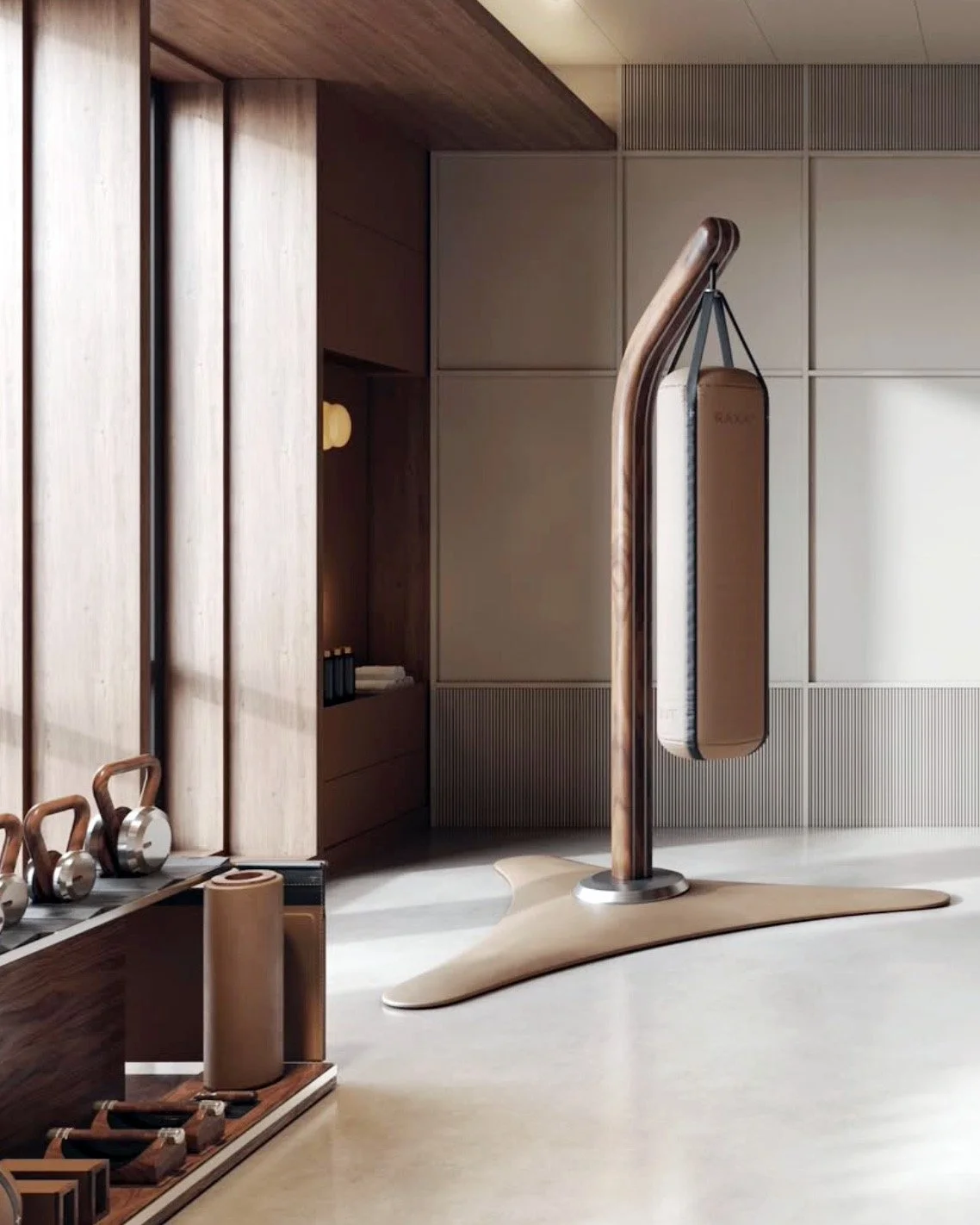
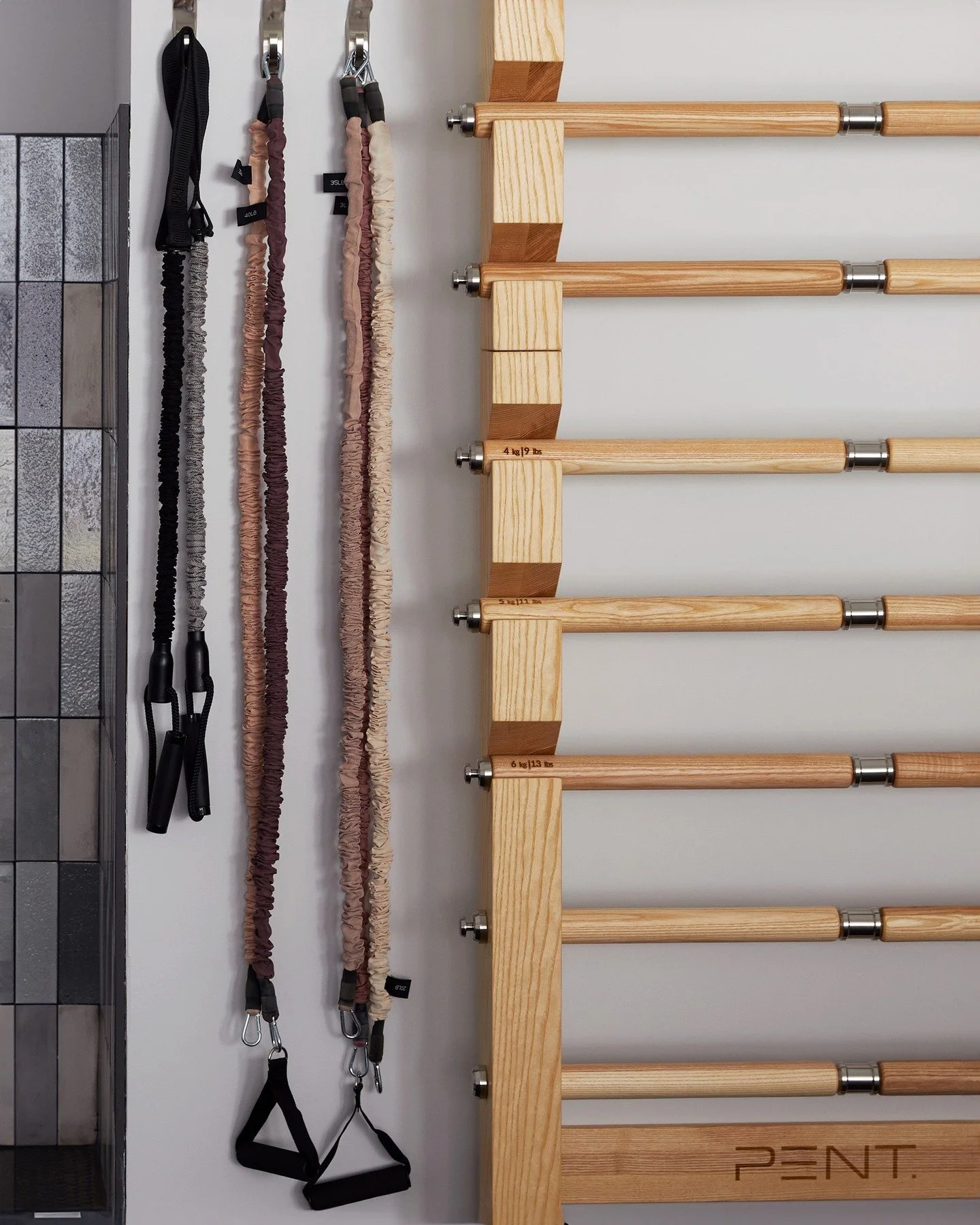
- PENT Fitness — Sculptural craftsmanship, made in Poland.
- NOHrD — Solid-wood functional German made equipment, architecturally stunning.
- Matrix — Smooth, quiet, premium commercial machines for refined spaces, with an outstanding warranty.
- TRX — Space-efficient suspension training for full-body work.
Functional & Cardio
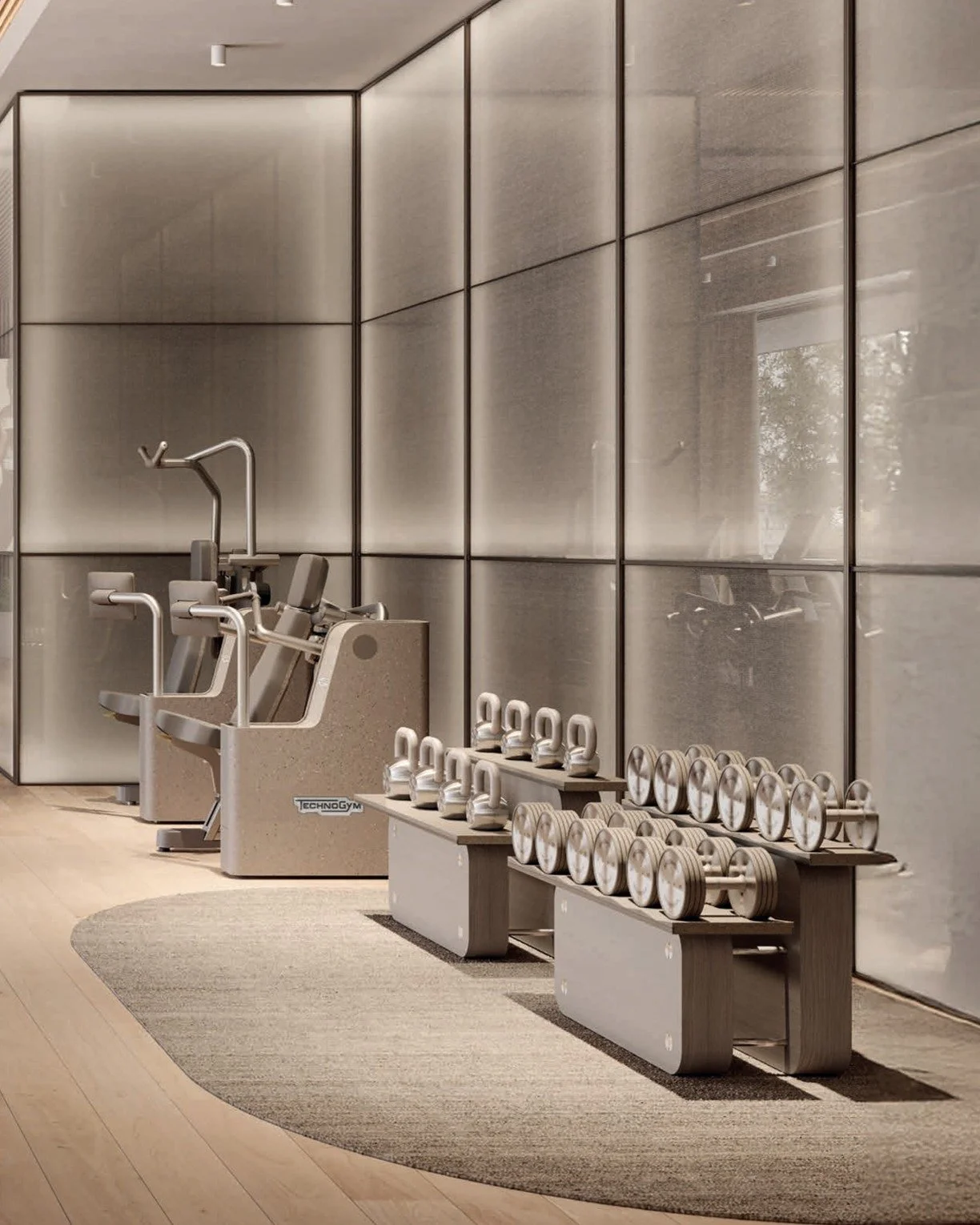
- Technogym — Italian design; whisper-quiet biomechanics.
- Woodway — Made in the USA. Woodway is the most premium treadmill available; low-impact slat belt.
- Concept2 — RowErg, SkiErg, BikeErg; durable, universal and the professional athletes go to.
- WaterRower — Hardwood, natural water resistance, quite possibly the most beautiful rower ever created.
- Assault Fitness — AirRunner and AirBike; self-powered intensity.
- Jacobs Ladder — Low-impact climber with full-body engagement.
- Matrix — Reliable, smooth cardio systems for home use.
Mindful Movement
- Balanced Body — Industry-leading reformers and Pilates tools.
- Merrithew — Modern, home-friendly Pilates equipment.
- NOHrD — Wood wall bars and elegant functional accessories.
- Manduka / Liforme — Premium mats and props.
- PENT — Luxury Pilates and yoga accessories.
Smart / Connected Training
- Tonal — Adaptive digital strength platform.
- Forme Life — Best-in-class form correction in a sleek mirror.
- OxeFit — Robotics-based strength analytics. This truly is the all-in-one machine.
- Power Plate — Vibration training for mobility and activation.
- Mirror — Classes, compact, lifestyle-friendly.
- Hydrow — Immersive rowing with scenic and competitive modes.
Recovery & Longevity
- Sunlighten / Clearlight — Infrared saunas with medical-grade components.
- Plunge / Cold Plunge / Renu Therapy — Precision cold therapy.
- Therabody — Percussion and recovery tools.
- Hyperice / Normatec — Compression for mobility and circulation.
- LightStim — Professional red light therapy.
- Joovv / Red Therapy Co. — Full-body red and NIR systems.
- HigherDOSE — Infrared and PEMF mats.
- BeWell — Cold plunges crafted for luxury homes.
The Real Question: What Do You Actually Need?
We design around your training history, injury patterns, goals, lifestyle, and joy factors. A luxury gym is not about how much equipment you own — it’s about choosing the right tools for how you move.
Equipment doesn’t make the gym luxury — alignment does.
Equipment We Generally Avoid (and Why)
- All-in-one machines — Poor biomechanics, low progression, bad resale.
- Cheap Olympic sets — Rust, wobble, inconsistent weights.
- Sub-$1,500 smart bikes — Flimsy frames and subscription traps.
- Gimmick equipment — Dust collectors that don’t support real training.
- Oversized commercial machines — They dominate home spaces.
- Low-end treadmills — Loud, weak motors, short lifespan.
- Foldable equipment — Almost always unstable under load.
- Cheap adjustable dumbbells — Plastic internals that break.
- Amazon-brand racks/cables — Thin steel, questionable safety.
We’re not anti-gadget — we’re anti-clutter, anti-waste, and anti-equipment that pretends to be training.
Design & Aesthetics — Making the Gym Beautiful
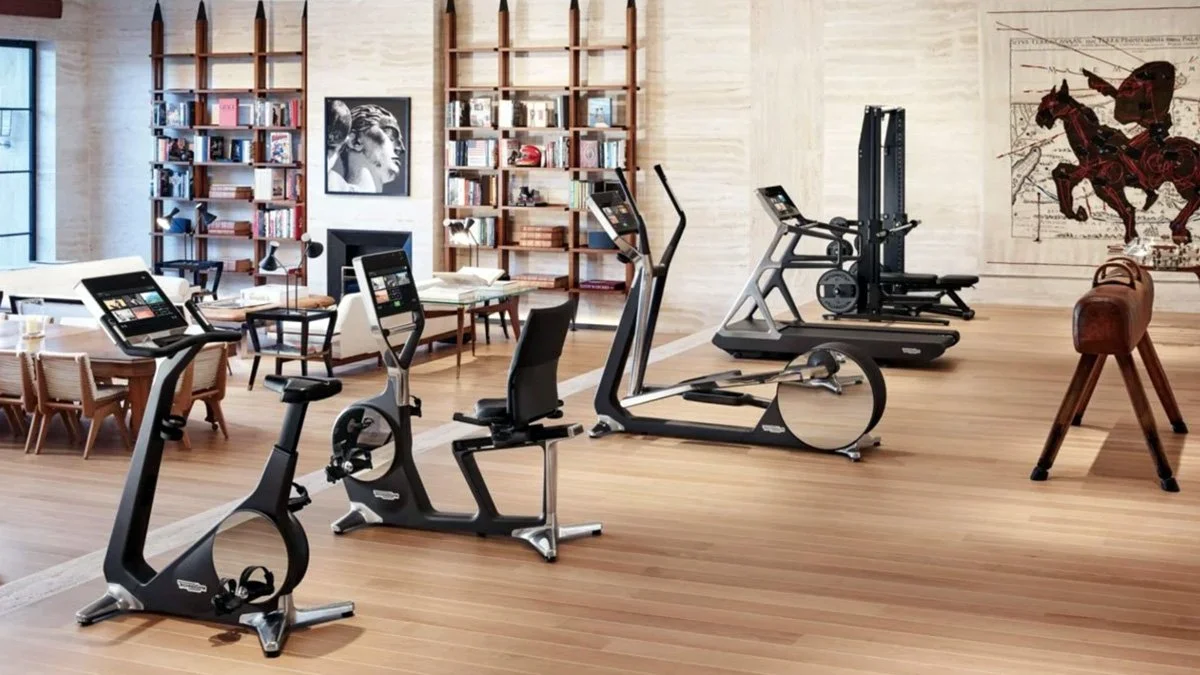
A home gym should look like it belongs in your home — not like a commercial fitness studio dropped into the basement. Good design shapes emotion, routine, and consistency. Over the years, we’ve identified four timeless aesthetic directions that clients naturally gravitate toward, each of which can be customized to your architecture.
1. Modern Minimalist — Scandinavian / Japanese-Inspired
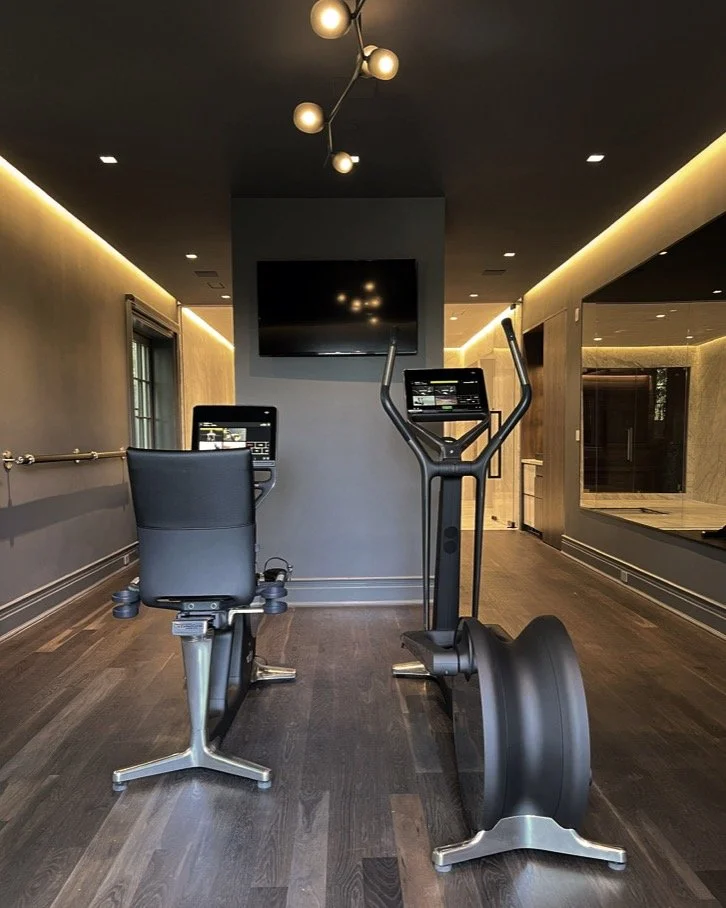
Clean lines, warm woods, textured plaster, black steel. Soft lighting, breathable space, everything stored out of sight. Ideal for people who crave calm and clarity.
2. Industrial Strength — Raw, Honest, Architectural
Exposed brick, sealed concrete, steel, reclaimed wood, moody tones, and straightforward equipment. Perfect for garage conversions and clients motivated by grit and authenticity.
3. Spa Sanctuary — Natural, Calming, Wellness-Forward
Oak or teak, linen, wool, stone, greenery, warm neutrals. Integrates beautifully with saunas, plunges, and meditation corners. Designed for clients prioritizing longevity and nervous-system regulation.
4. Tech-Forward Smart Integration — Invisible Technology
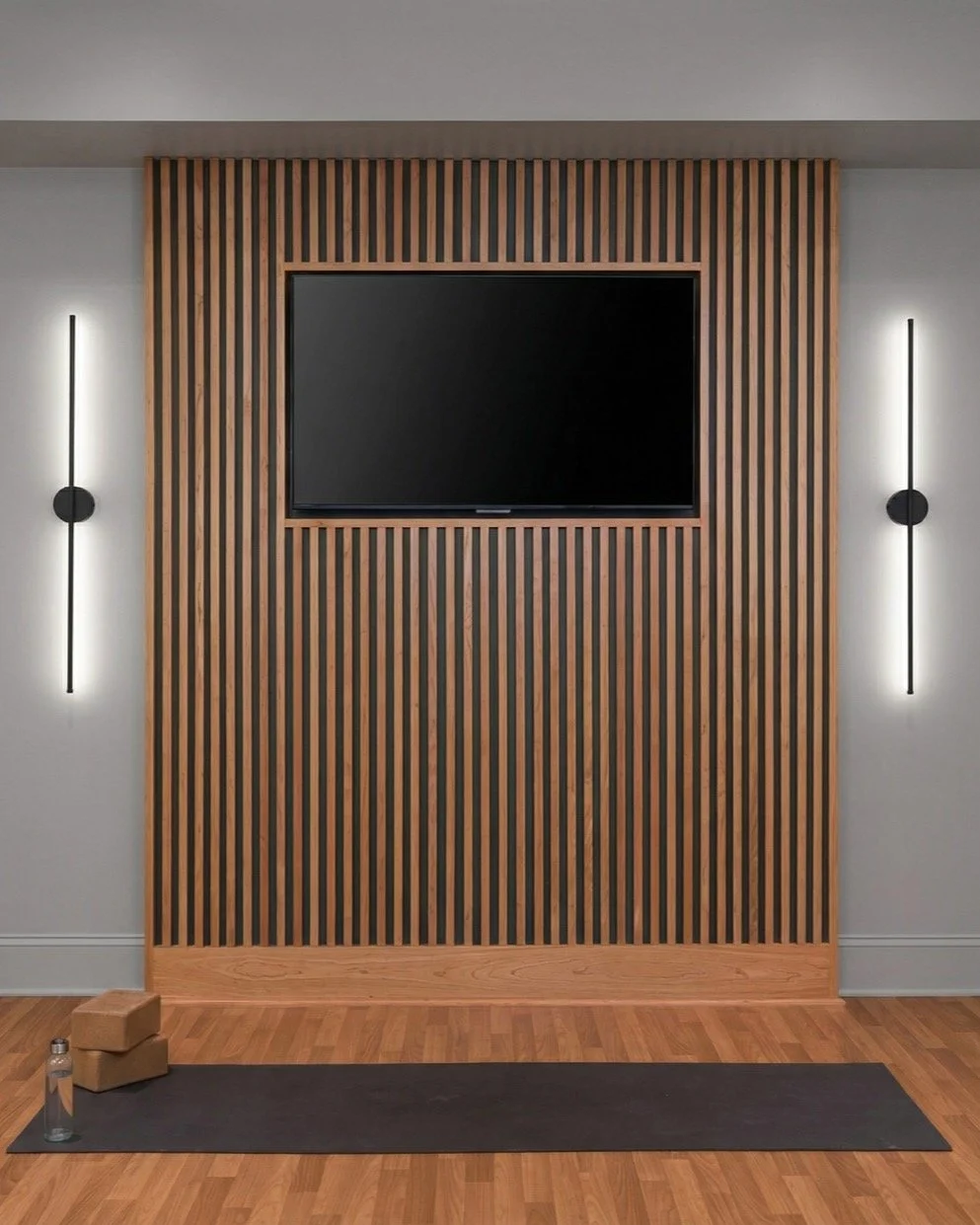
Integrated screens, hidden speakers, projection, automated lighting, voice control, and monochromatic palettes. Perfect for compact spaces and people who want zero friction.
Design Elements That Transcend Style
Certain elements appear in every Iron House Estate Project because they quietly elevate the room:
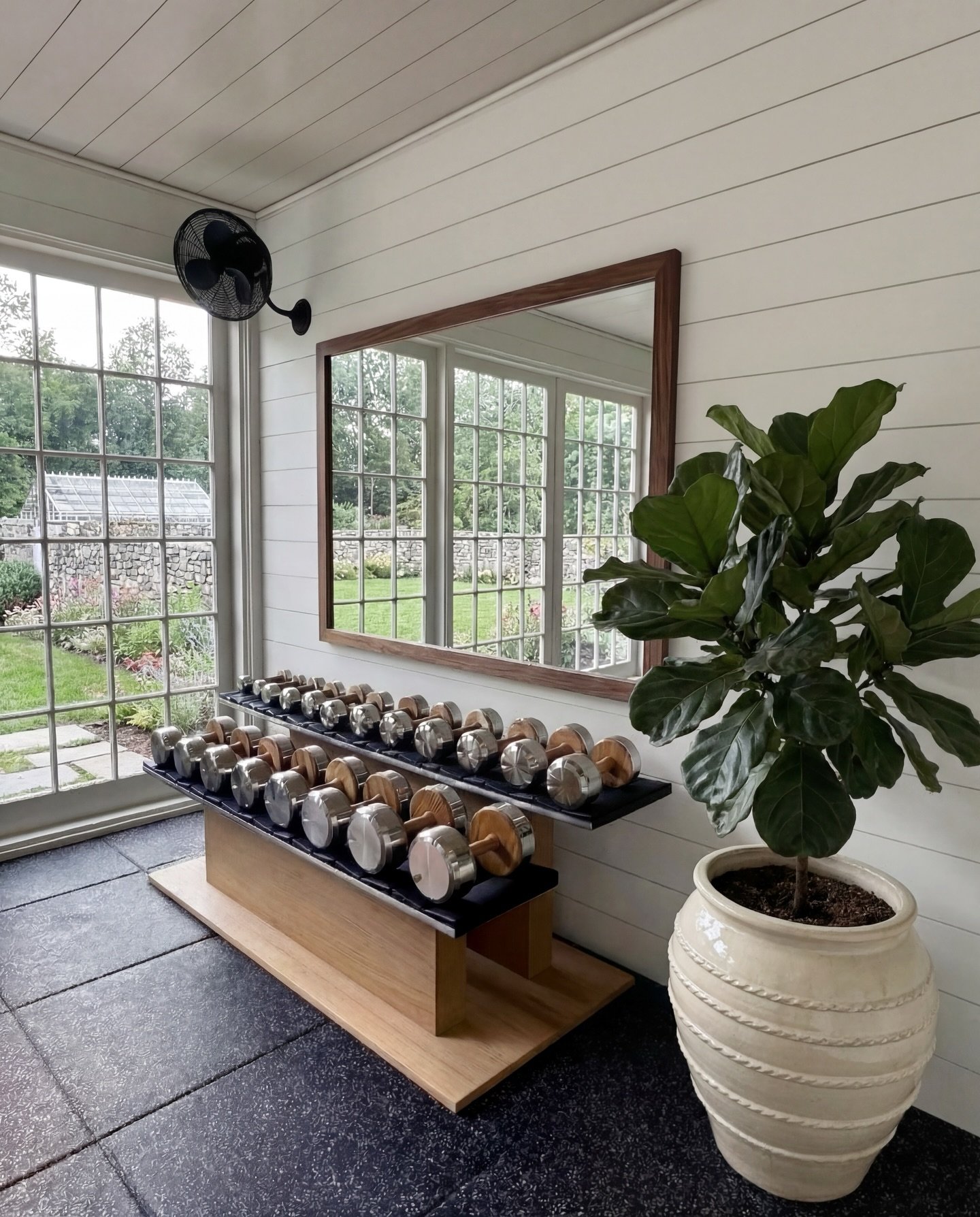
- Mirrors done right: ¼-inch glass, distortion-free, never all four walls.
- Acoustic treatment: Fabric-wrapped panels that absorb echo and add softness.
- Air quality: MERV-13+ filtration; optional HEPA for wellness suites.
- Biophilic elements: Plants, living walls, grounding natural textures.
- Layered lighting: Ambient + task + accent + natural.
- Custom millwork: Built-in storage, towel drawers, integrated plate racks.
These elements transform a room from “nice” to architectural luxury. They’re the details people don’t always notice consciously — but they always feel.
Flooring — The Foundation of a Proper Gym
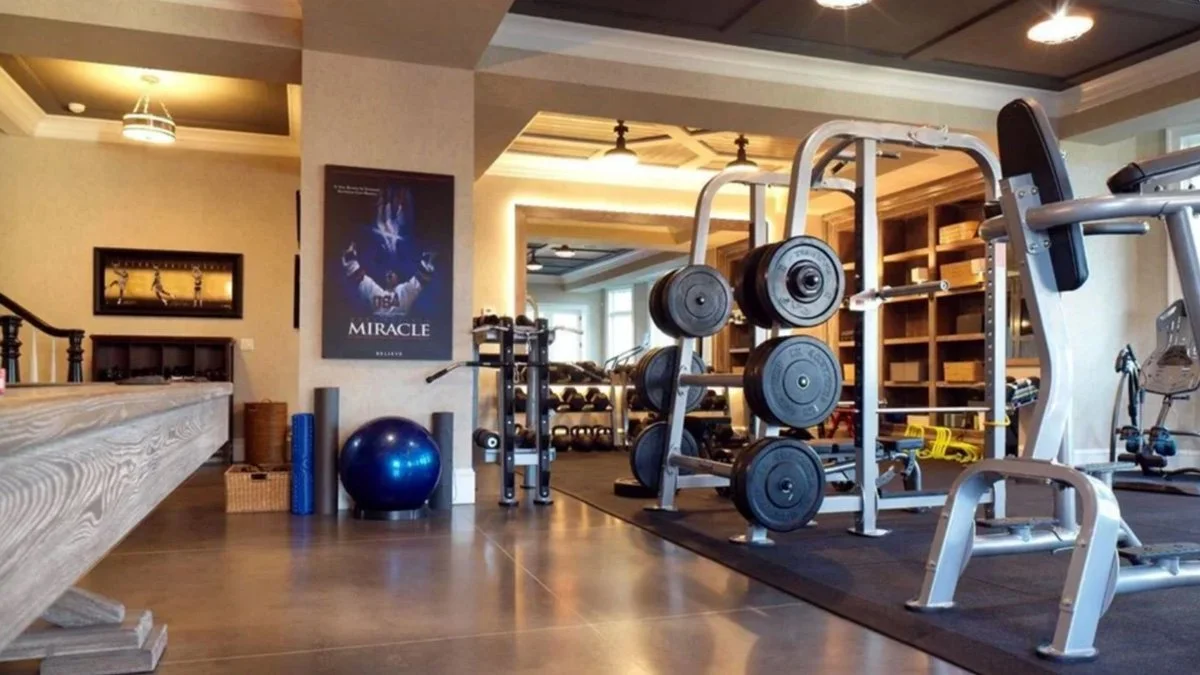
Flooring is the quiet backbone of every home gym. It affects safety, noise, equipment longevity, and how the room feels under your feet. Because flooring is difficult to change later, we prioritize it early in every design. The right surface protects your body and your investment — the wrong one becomes a daily frustration.
The Four Flooring Categories We Trust
1. Rubber Flooring — For Strength
The only reliable surface for heavy lifting, impact absorption, and vibration control. Ideal for barbell work and commercial-grade equipment. Not glamorous — but essential.
2. LVP & Engineered Hardwood — For Mindful Movement
Warm, beautiful surfaces ideal for Pilates, yoga, and recovery work. Not suited for heavy strength, but exceptional when wellness and aesthetics are the priority.
3. Artificial Turf — For Functional Training
Perfect for sled work, agility drills, and open functional zones. Adds athletic energy and warmth. Should never sit under heavy equipment.
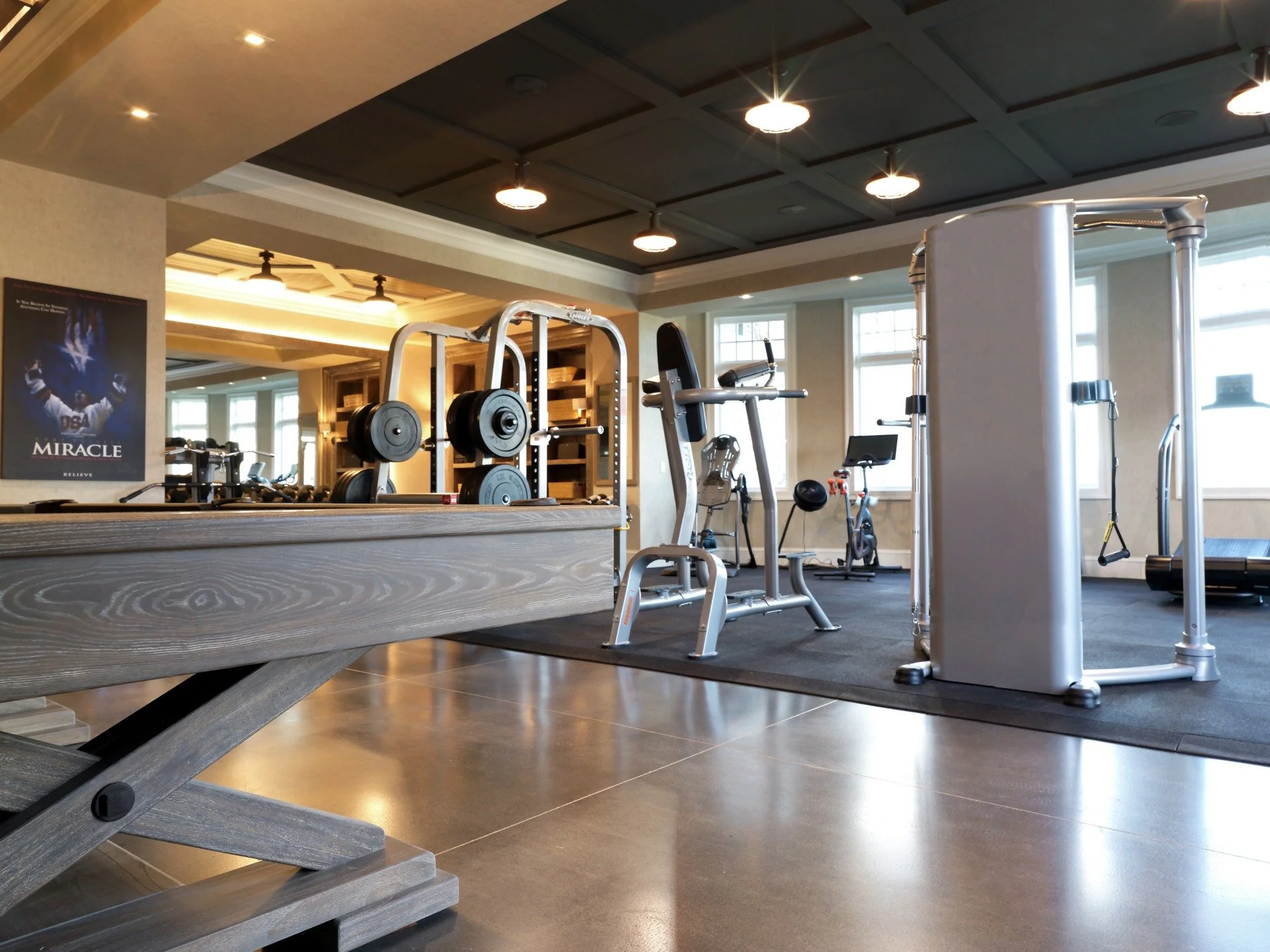
4. Polished or Stained Concrete — Modern & Indestructible
Stunning in large estate gyms, garages, and basements. Low-maintenance, architectural, and durable. Paired beautifully with radiant heat.
How We Assign Flooring by Zone
- Strength: Rubber
- Functional/Cardio: Rubber or turf
- Mindful movement: LVP or engineered hardwood
- Mobility/stretching: Same as mindful movement + mats
- Recovery suites: Tile for wet; LVP/wood for dry
Subfloor conditions determine sound control and long-term durability. We handle this for every project to prevent noise transfer — especially for upstairs gyms.
Wellness & Longevity Rooms — The New Luxury Standard
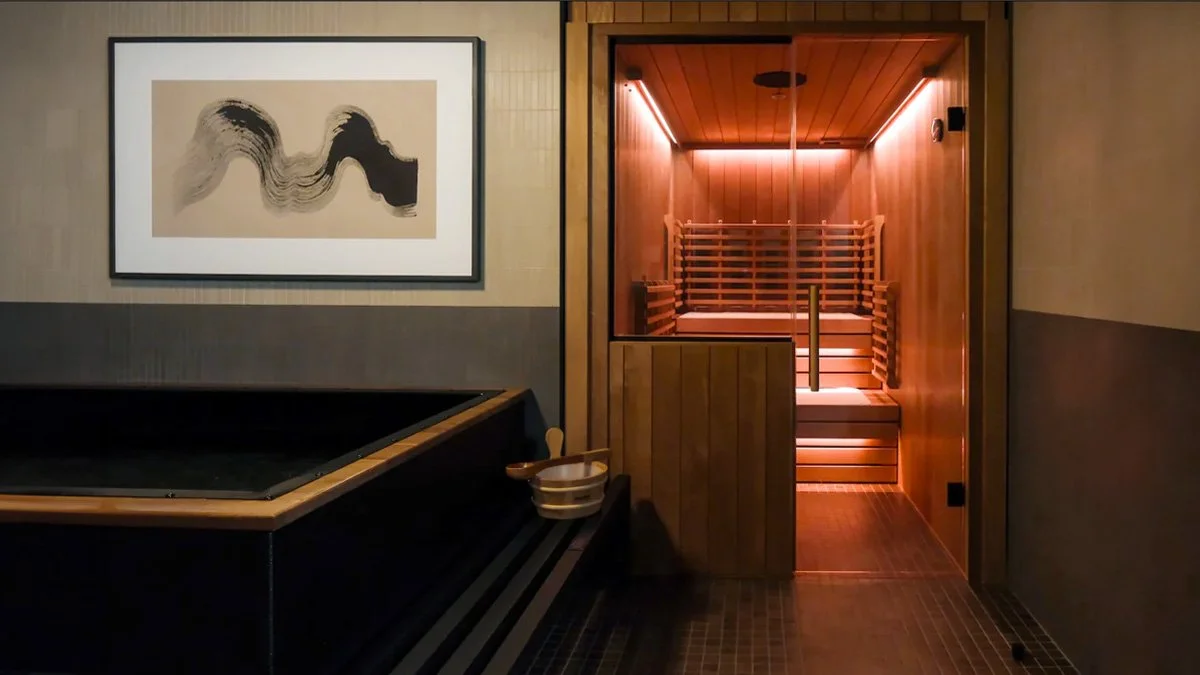
A true luxury gym doesn’t end with the workout — it extends into recovery, longevity, and restoration. This is where your gym becomes a wellness suite, supporting the physiology that makes training sustainable long-term.
“Iron House didn’t just design a gym. They designed how I recover. The wellness space became part of my daily rhythm.” — Christi C., Texas
Core Wellness Features
Infrared Saunas
Low-EMF, fast installation, mood-enhancing, and clinically backed for inflammation reduction. A top choice in nearly every wellness-forward space.
Cold Plunges
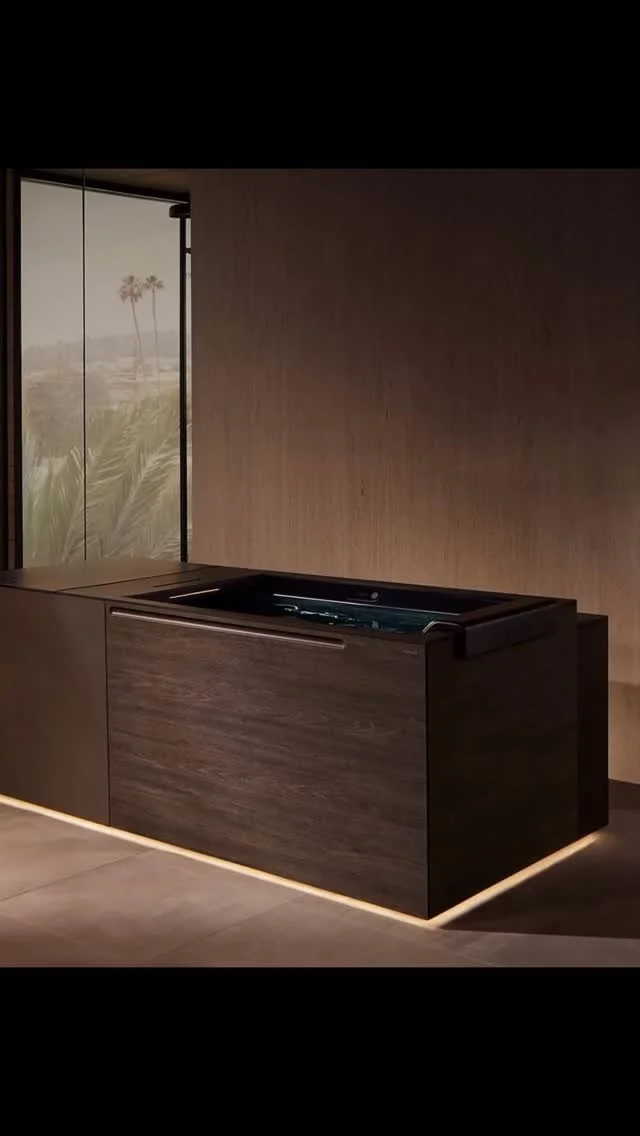
High-impact recovery that improves sleep, mood, and hormonal balance. Built-in or standalone options fit most homes.
Red Light Therapy
Supports mitochondrial function, skin health, recovery, and overall energy — just minutes per day.
Compression Therapy
Normatec and Hyperice systems improve circulation, reduce soreness, and accelerate recovery.
In larger homes, these features expand into full recovery lounges with HEPA-level air quality, meditation nooks, breathwork corners, and spa-grade seating. Whether compact or grand, a wellness suite turns your gym into a longevity space.
The Construction Details Most Designers Miss
Most “home gym” designs fail before equipment arrives — not because of layout, but because the architectural planning was never addressed. At Iron House, we treat your gym like a built environment, not a spare room.
Eight Critical Details
1. Ceiling Height
Anything under 8 ft risks compromising some strength training and Pilates equipment choices. Gyms under 8 ft can be built, but your equipment choices need to reflect that height.
2. Electrical Requirements
Treadmills, saunas, plunges, and smart systems often require dedicated circuits. Fixing this later means opening walls — avoidable with proper planning.
3. HVAC & Fresh Air
Gyms need more oxygen turnover and better temperature control than standard rooms. Without it, the space feels stuffy and uncomfortable.
4. Sound Control
Dropped weights and running create vibrations throughout the home. We plan for:
- acoustic underlayment
- proper rubber thickness
- floating floors
- strategic equipment placement
5. Wall and/or Ceiling Reinforcement
Some racks, cable machines, wall bars, pull-up bars, wall ball areas, heavy bags, and smart equipment require reinforced walls or ceilings. We plan for this on day one.
6. Moisture Protection
Saunas and plunges require waterproofing, tile, membranes, and proper ventilation.
7. Smart Lighting Infrastructure
Circadian lighting requires the right dimmers, drivers, circuits, and zoning — ideally planned before drywall.
8. Real Storage — Custom Sized
Bands, bolsters, reformer boxes, plates, towels — none of this fits standard cabinetry. We can help design customized millwork so everything has a home.
Luxury only feels effortless because the construction behind it wasn’t.
What Does a Luxury Home Gym Cost? (The Real Numbers)
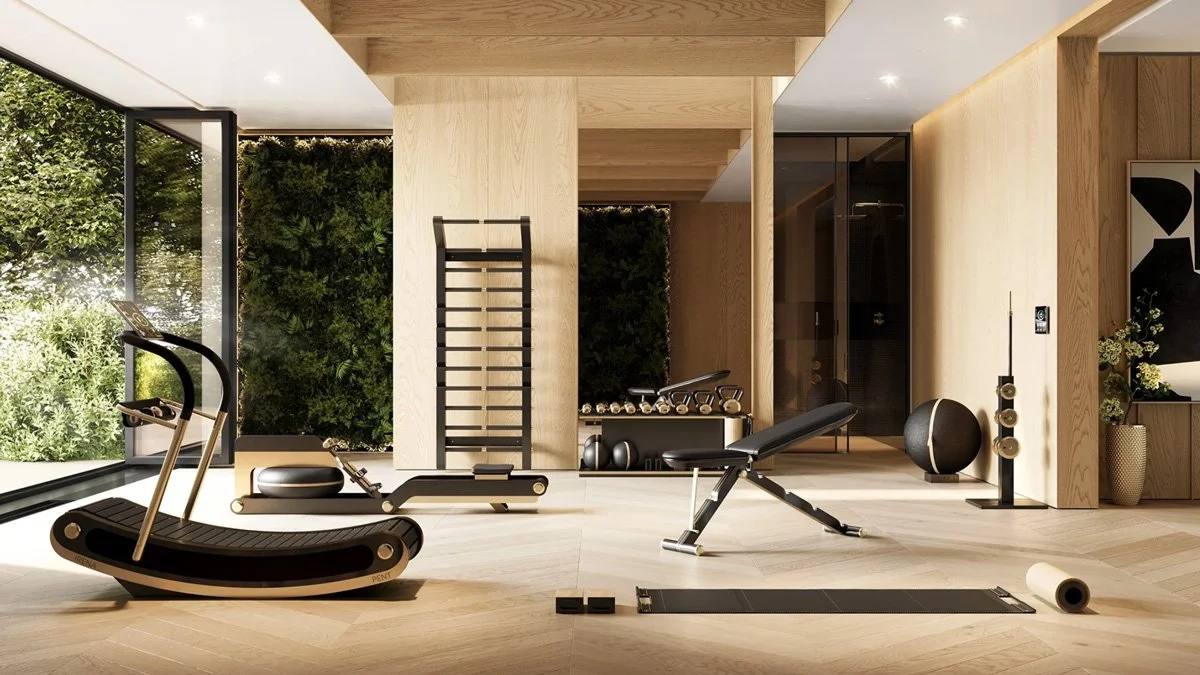
Costs vary by size, equipment tier, flooring, lighting, storage, and whether we’re adding wellness elements or custom millwork. Here are the transparent ranges we share with clients:
Investment Ranges
Entry-Level Luxury: $15,000–$45,000
A beautifully designed single-room gym with strong foundational equipment.
Mid-Level Luxury: $45,000–$100,000
A complete gym with multiple zones, upgraded finishes, and select wellness features.
High-End Custom: $100,000–$250,000+
Architecture-integrated, elevated materials, acoustics, lighting, and top-tier equipment.
Gym + Wellness Suite: $75,000–$300,000
A full gym plus sauna, cold plunge, red light therapy, recovery, and built-ins.
Where Most Projects Go Over Budget
- Structural surprises during construction
- Mid-project equipment upgrades
- Scope expansion (adding sauna, plunge, etc.)
- Change orders after equipment is ordered
How We Prevent This
- Comprehensive upfront assessments
- Firm equipment selections
- Realistic allowances
- Transparent communication
Our guarantee: No surprises. You receive an itemized budget before anything begins.
Timeline: From First Call to First Workout
Every project moves at a slightly different pace depending on decision-making, construction timelines, and manufacturer lead times — but most follow this predictable rhythm:
Consultation → Initial Layout (2 Weeks)
We begin with your measurements (from your architect or a professional that signs off on the measurements), photos, and a conversation about your goals. Layouts delivered in ~2 weeks. Revisions in 1–3 days.
Final Design → Builder Coordination (1–4 Weeks)
We finalize finishes, flooring, lighting, and equipment. Then we coordinate with your builder so electrical, HVAC, and reinforcements are done correctly before construction begins.
Construction & Preparation (Varies)
Dependent entirely on your contractor. Some spaces take 30 days; others take several months.
Honest Equipment Lead Times (4–23+ Weeks)
- Flooring: 4–12 weeks
- Tonal & Peloton: 4–8 weeks
- Standard brands: 8–16 weeks
- Luxury brands: 16–23+ weeks
- PENT & other custom equipment: 23+ weeks
- Customs clearance: 3 days to 3 weeks
Delivery, Installation & Styling
Once equipment arrives at our local trucking partner, installation is scheduled — typically 1–2 weeks.
Then comes the best part: your first workout in a space that finally feels like you.
“Working with Iron House was effortless. Tanya & Jim understood what we wanted before we could fully articulate it. I even flew them out so that they could see their work and how happy we were with the completed gym.” — Anthony R., Chicago
Working With Iron House: Our Process
We’re a small, highly specialized, family-owned firm. When you work with Iron House, you work directly with Tanya on design and with Jim on equipment and performance. Our process is personal, structured, and deeply considered.
Our Design Fee
A one-time flat creative services fee per room that includes 2D/3D layouts, zoning, finishes, builder requirements, equipment curation, and all revisions.
Typical Total Investment (Design + Build + Equipment)
- Compact: $5,000–$15,000
- Optimal: $15,000–$50,000
- Estate: $50,000–$100,000+
The Four-Phase Process
Phase 1: Design & Layout (Weeks 1–4)
Measurements, goals, zoning, finishes, layouts. Revisions in 1–3 days.
Phase 2: Final Design & Builder Coordination
We finalize equipment and communicate with your builder or designer so structural and electrical elements are done correctly.
Phase 3: Procurement & Logistics
If equipment is purchased through us (MSRP, no surcharge), we handle all ordering, tracking, shipping, and scheduling.
Phase 4: Installation & Styling
When construction is complete and equipment arrives, we coordinate installation, spacing, and final styling.
We take fewer projects so every client receives personal attention. Whether you’re working with a full design team or completely solo — we fit seamlessly.
Common Mistakes to Avoid
- Buying equipment first — then trying to “make it fit” later.
- Skipping zoning — the room feels chaotic, so you stop using it.
- Under-planning electrical/HVAC — opening walls later is expensive and avoidable.
- Wrong flooring — noise, odor, wear, and daily frustration.
- Not planning storage — clutter kills luxury faster than anything.
- Ignoring ceiling height — limits racks, Pilates, and overhead movement.
- Forgetting recovery — training is only sustainable when restoration is built in.
Frequently Asked Questions
Do I need a large space?
No. We regularly design high-performance gyms in 150–250 sq ft spaces. Intelligent zoning beats square footage.
Do you work nationally?
Yes — most of our projects are remote. Our process is designed to work seamlessly anywhere in the U.S.
Do I need to purchase equipment through Iron House?
No, but when you do, procurement and installation coordination are free — and we handle all logistics start to finish.
Can you work with my architect or interior designer?
Absolutely. Many of our projects are collaborations with design teams. We also lead projects independently.
How soon should I start?
The earlier the better — especially if you’re building or renovating. Electrical, HVAC, and wall reinforcement must be planned before drywall.
Your home gym should feel effortless — because the planning behind it wasn’t.
Click the button below to get started. Not quite ready? Visit our clients page to see what some of our other other favorite people have had to say. Or even better, check out this letter of recommendation from one of our loyal and long time client’s.